
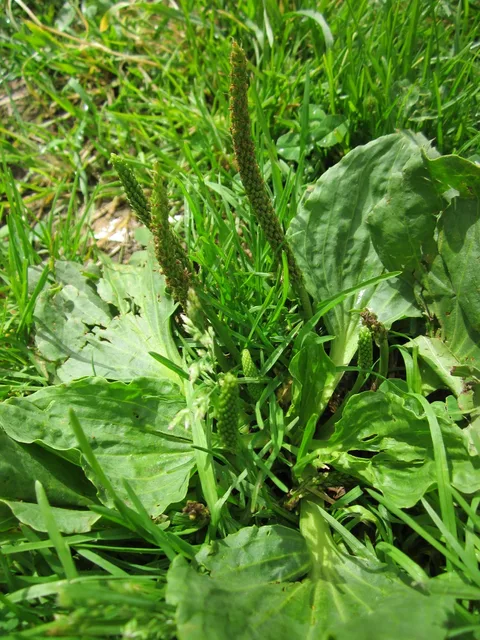
Breit-Wegerich
Plantago major
Plantae · Tracheophyta · Plantaginaceae · Plantago · Lamiales · Magnoliopsida
Auch: Plantago adriatica, Plantago altissima, Plantago angustata, Plantago borysthenica, Plantago bracteata, Plantago compressiscapa, Plantago crenata, Plantago dentata, Plantago dilatata, Plantago dostalii, Plantago dregeana, Plantago exaltata, Plantago fonticola, Plantago gigas, Plantago gouanii, Plantago gracilis, Plantago humifusa, Plantago jehohlensis, Plantago jepohlensis, Plantago laciniosa, Plantago latifolia, Plantago limosa, Plantago longiscapa, Plantago loureiroi, Plantago majo fma, Plantago maxima, Plantago media procera, Plantago minima, Plantago minor, Plantago nana, Plantago officinarum, Plantago pauciflora, Plantago polystachia, Plantago quinquenervis, Plantago rocae, Plantago rosea, Plantago sawadae, Plantago sawadai, Plantago sinuata, Plantago sorokini
Über die Pflanze
Ausdauernde, krautige Pflanze mit ovalen bis lanzettlichen Blättern und dichten, aufrechten Ähren.
Wirkung
- entzündungshemmend
- schleimlösend
Anwendung
- Extern
- ['Pflanzliche Umschläge bei Insektenstichen, Verbrennungen, Ekzemen, Wunden']
- Intern
- ['Tee bei Husten und Halsschmerzen']
Überlieferte Heilwirkungen
- ekspektrant
- dregëzuese
Erkennungsmerkmale
Grundständige Rosette mit ovalen bis lanzettlichen Blättern und dichten, aufrechten Ähren.
Wuchs
Hemikryptophyt
Standort
Sonnig bis halbschattig, nährstoffreicher Boden
Herkunft
Eurasien, Nordafrika, Nordasien
Verwendete Pflanzenteile
- Blatt
Zubereitung
- Tee
Sammeln
- Monate: [3, 4, 5, 9, 10] · Hinweis: Vermeiden Sie das Sammeln während der Blütezeit, da die Blätter dann bitter werden. · Bedingungen: Junge Blätter im Frühjahr sind am zartesten und besten für die Verwendung. · Pflanzenteil: Blatt · Reifezustand: vor Reife|Frühling
- Monate: [8, 9] · Hinweis: Samen sind sehr klein und schwer zu sammeln. · Bedingungen: Reife Samen sind braun-grau und trocken. · Pflanzenteil: Samen · Reifezustand: reif|Spätsommer bis Herbst
- Monate: [10, 3] · Hinweis: Wurzeln werden weniger genutzt als Blätter. · Bedingungen: Wurzeln sind traditionell im Herbst nach dem ersten Frost oder im Frühling vor dem Austrieb gesammelt. · Pflanzenteil: Wurzel · Reifezustand: vor Austrieb|Herbst oder frühes Frühjahr
Inhaltsstoffe
- ursolic acid
- stigmast-5-en-3-ol, (3β)-
- stigmast-5-en-3-ol
- asperuloside
- 3-{[3-(3,4-dihydroxyphenyl)prop-2-enoyl]oxy}-1,4,5-trihydroxycyclohexane-1-carboxylic acid
- asperuloside
- chlorogenic acid
- phytosterol
- quercetin
- citric acid
- hexacosane
- nonacosane
- methyl 3-(3,4-dihydroxyphenyl)prop-2-enoate
- (-)-malic acid
- tritriacontane
- ferulic acid
- tetratriacontane
- amyrin
- pentacosane
- syringic acid
- 2,5-dihydroxybenzoic acid
- nepitrin
- luteolin 7-o-glucuronide
- aucubin
- dotriacontane
- rutin
- methyl (9r,11z)-9-hydroxyoctadec-11-enoate
- hyperoside
- plantagoside
- verbascoside
Ätherische Öle
- ursolic acid
- asperuloside
- 10-hydroxy-1,2,6a,6b,9,9,12a-heptamethyl-2,3,4,5,6,7,8,8a,10,11,12,12b,13,14b-tetradecahydro-1h-picene-4a-carboxylic acid
- asperuloside
- (2s,3r,4s,5r,6r)-2-{[(1s,4as,5r)-5-hydroxy-7-(hydroxymethyl)-1h,4ah,5h,7ah-cyclopenta[c]pyran-1-yl]oxy}-6-(hydroxymethyl)oxane-3,4,5-triol
- (2r)-2-{[(1r,2s,6s)-5-hydroxy-2-(hydroxymethyl)-3,9-dioxatricyclo[4.4.0.0²,⁴]dec-7-en-10-yl]oxy}-6-(hydroxymethyl)oxane-3,4,5-triol
- 2-({5,6-dihydroxy-2-methyl-3,9-dioxatricyclo[4.4.0.0²,⁴]dec-7-en-10-yl}oxy)-6-(hydroxymethyl)oxane-3,4,5-triol
- methyl (1s,4as,6s)-7-[(acetyloxy)methyl]-6-hydroxy-1-{[(2s,3r,4s,5s,6r)-3,4,5-trihydroxy-6-(hydroxymethyl)oxan-2-yl]oxy}-1h,4ah,5h,6h-cyclopenta[c]pyran-4-carboxylate
- amyrin
- (2s,3r,4s,5s,6r)-2-{[(2r,3r,4s,5s,6r)-2-{[(1s,4as,5r,7ar)-5-hydroxy-7-(hydroxymethyl)-1-{[(2s,3r,4s,5s,6r)-3,4,5-trihydroxy-6-(hydroxymethyl)oxan-2-yl]oxy}-1h,5h,7ah-cyclopenta[c]pyran-4a-yl]oxy}-4,5-dihydroxy-6-(hydroxymethyl)oxan-3-yl]oxy}-6-(hydroxymethyl)oxane-3,4,5-triol
- aucubin
- 7-(hydroxymethyl)-1-{[3,4,5-trihydroxy-6-(hydroxymethyl)oxan-2-yl]oxy}-1h,4ah,5h,7ah-cyclopenta[c]pyran-4-carboxylic acid
- methyl (1s,4as,6s)-6-hydroxy-7-methyl-1-{[(2s,3r,4s,5s,6r)-3,4,5-trihydroxy-6-(hydroxymethyl)oxan-2-yl]oxy}-1h,4ah,5h,6h-cyclopenta[c]pyran-4-carboxylate
- (1r,4ar,7ar)-7-(hydroxymethyl)-1-{[(2s,3r,4s,5s,6r)-3,4,5-trihydroxy-6-(hydroxymethyl)oxan-2-yl]oxy}-1h,4ah,5h,7ah-cyclopenta[c]pyran-4-carboxylic acid
- (1s,4as,7s,7as)-7-hydroxy-7-methyl-1-{[(2s,3s,4s,5s,6r)-3,4,5-trihydroxy-6-(hydroxymethyl)oxan-2-yl]oxy}-1h,4ah,5h,6h,7ah-cyclopenta[c]pyran-4-carbaldehyde
In der Küche
- Kalorien
- 18
- Protein
- 2.29
- Kohlenhydrate
- 2.03
- Ballaststoffe
- 3.88
- Fett
- 0.18
Sicherheit und Wechselwirkungen
Giftigkeit
keine
Herkunft der Einstufung: Breitwegerich ist Wildgemüse und alte Wundheildroge; Aucubin und Schleimstoffe, keine toxikologisch relevanten Inhaltsstoffe.
Gegenanzeigen
- Allergien gegen Plantago oder andere Wegericharten
- Schwangerschaft (nach Rücksprache mit Arzt)
Höchstmenge
pihet dy tri gota në ditë
Wechselwirkungen
Zu Wechselwirkungen liegen uns hier keine Angaben vor. Das heißt nicht, dass es keine gibt. Wenn du Medikamente nimmst, frag bitte deine Ärztin oder in der Apotheke nach.
Dieser Eintrag wird noch ergänzt.
Als PDF mitnehmen