
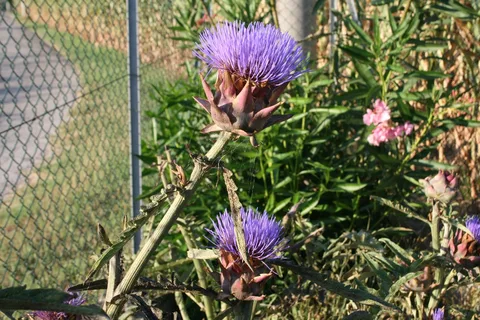
Artischocke und Cardy
Cynara cardunculus
Plantae · Tracheophyta · Asteraceae · Cynara · Asterales · Magnoliopsida
Auch: Cynara humilis, Cynara cardunculus var. altilis, Cynara cardunculus var. sylvestris
Über die Pflanze
Eine vielseitige Pflanze mit wilden und kultivierten Formen, die sowohl als Nahrungsmittel, Heilpflanze als auch Zierpflanze genutzt wird.
Wirkung
Leberunterstützung, Blutzuckerregulation, entzündungshemmend, cholesterinsenkend
Anwendung
Tee aus den Blättern und Stängeln, Tinktur in der Homöopathie und traditionellen Medizin
Volksmedizin im deutschsprachigen Raum
Arzneipflanze des Jahres 2003: Artischocke.
Überlieferte Heilwirkungen
- bei Verdauungsproblemen und Leberbeschwerden helfen soll
Überliefertes Wissen
Grieche, römische und persische Küche; spätere Nutzung in Europa, Südamerika, Nordafrika
Erkennungsmerkmale
stachelige Blätter und korbförmige Blütenstände
Wuchs
Halbstrauch oder mehrjährig
Blütezeit
- Mai–September (Wildform), April–Oktober (Kultivar)
Standort
trocken-warme Standorte (Steppen, Wegränder, Kulturland)
Herkunft
ursprünglich im Mittelmeerraum
Verwendete Pflanzenteile
- junge Blätter, Knospen (Blütenstände), Stängel
Zubereitung
- Tee
- Tinktur
- Trockenextrakt
Erntezeit
- Teil: Blatt · Monate: [5, 6, 7, 8, 9] · Hinweis: vor der Blüte, jung und zart (z.B. als Spinatersatz) · Mondphase: abnehmend
- Teil: Samen · Monate: [8, 9] · Hinweis: Reif im Spätsommer · Mondphase: zunehmend
- Teil: Wurzel · Monate: [3, 10, 11] · Hinweis: Frühling oder Herbst (nach der Blüte) · Mondphase: abnehmend
Sammeln
- Monate: [4, 5, 9, 10] · Hinweis: Junge Blätter für Salate oder gekocht verwenden. Frisch oder im Schatten und luftig trocken. · Bedingungen: Sonnige, trockene Standorte (z. B. Wegränder, Brachen, Kulturpflanzen). Vermeiden von stark belasteten Gebieten. · Pflanzenteil: Blatt · Reifezustand: vor Reife|Knospe|null
- Monate: [6, 7] · Hinweis: Als Gemüse oder eingelegt verwenden. · Bedingungen: Sonnige, trockene Standorte (z. B. Wegränder, Brachen, Kulturpflanzen). Vermeiden von stark belasteten Gebieten. · Pflanzenteil: Blüte|Blütenknospe · Reifezustand: vor Reife|null
- Monate: [3, 4, 10, 11] · Hinweis: Selten genutzt, aber als Heilmittel (harntreibend, verdauungsfördernd) oder frisch als Tee verwenden. · Bedingungen: Sonnige, trockene Standorte (z. B. Wegränder, Brachen, Kulturpflanzen). Vermeiden von stark belasteten Gebieten. · Pflanzenteil: Wurzel · Reifezustand: vor Reife|null
Inhaltsstoffe
- luteolin 7-o-glucuronide
- chlorogenic acid
- luteolin 7-o-glucoside
- luteolin
- 1,1,7,7a-tetramethyl-1ah,2h,3h,5h,6h,7h,7bh-cyclopropa[a]naphthalene
- β-amyrin
- carotenoid
- pyridine
- prunin
- 24-methylene-cycloartanol
- amyrin
- 9,12,13-trihydroxyoctadec-10-enoic acid
- 4-hydroxy-9-methyl-3,6-dimethylidene-octahydroazuleno[4,5-b]furan-2,8-dione
- luteolin 7-rutinoside
- 4,5-dicaffeoylquinic acid
- cynarine
- longifolene
- 3-(chloromethyl)-3-hydroxy-9-methyl-6-methylidene-octahydroazuleno[4,5-b]furan-2,8-dione
- β-selinene
- 1,4-bis({[(2e)-3-(3,4-dihydroxyphenyl)prop-2-enoyl]oxy})-3,5-dihydroxycyclohexane-1-carboxylic acid
- calenduloside f
- chamomile
- 3-o-feruloyl-d-quinic acid
- 2-phenyl-ethanol
- cedrene
- taraxasterol acetate
- β-amyrin acetate
- humulene
- 3,8-dihydroxy-3-(hydroxymethyl)-9-methyl-6-methylidene-octahydro-3ah-azuleno[4,5-b]furan-2-one
- (2z,4e,6e)-2-hydroxy-18-oxooctadeca-2,4,6-trienoic acid
Ätherische Öle
- (3r,3ar,6ar,8s,9s,9ar,9br)-3-hydroxy-3-(hydroxymethyl)-9-methyl-6-methylidene-8-{[(2r,3r,4s,5s,6r)-3,4,5-trihydroxy-6-(hydroxymethyl)oxan-2-yl]oxy}-octahydro-3ah-azuleno[4,5-b]furan-2-one
- 1,1,7,7a-tetramethyl-1ah,2h,3h,5h,6h,7h,7bh-cyclopropa[a]naphthalene
- (3s,3ar,4s,6ar,9s,9ar,9br)-3,9-dimethyl-6-methylidene-4-{[(2r,3r,4s,5s,6r)-3,4,5-trihydroxy-6-(hydroxymethyl)oxan-2-yl]oxy}-octahydro-3h-azuleno[4,5-b]furan-2,8-dione
- β-amyrin
- (2s,3s,4s,5r,6r)-6-{[(3s,4r,4ar,6ar,6bs,8as,11r,12s,12as,14ar,14br)-4-(hydroxymethyl)-4,6a,6b,11,12,14b-hexamethyl-8a-({[(2s,3r,4s,5s,6r)-3,4,5-trihydroxy-6-(hydroxymethyl)oxan-2-yl]oxy}carbonyl)-2,3,4a,5,6,7,8,9,10,11,12,12a,14,14a-tetradecahydro-1h-picen-3-yl]oxy}-3,4-dihydroxy-5-{[(2r,3r,4s,5s)-3,4,5-trihydroxyoxan-2-yl]oxy}oxane-2-carboxylic acid
- 24-methylene-cycloartanol
- (3s,3ar,4s,6ar,8s,9ar,9br)-8-hydroxy-3-methyl-6,9-dimethylidene-4-{[(2r,3r,4s,5s,6r)-3,4,5-trihydroxy-6-(hydroxymethyl)oxan-2-yl]oxy}-octahydro-3h-azuleno[4,5-b]furan-2-one
- 6-{[4,4,6a,6b,11,11,14b-heptamethyl-8a-({[3,4,5-trihydroxy-6-(hydroxymethyl)oxan-2-yl]oxy}carbonyl)-1,2,3,4a,5,6,7,8,9,10,12,12a,14,14a-tetradecahydropicen-3-yl]oxy}-3,4-dihydroxy-5-[(3,4,5-trihydroxyoxan-2-yl)oxy]oxane-2-carboxylic acid
- amyrin
- 3-hydroxy-3-(hydroxymethyl)-9-methyl-6-methylidene-8-{[3,4,5-trihydroxy-6-(hydroxymethyl)oxan-2-yl]oxy}-octahydro-3ah-azuleno[4,5-b]furan-2-one
- 4-hydroxy-9-methyl-3,6-dimethylidene-octahydroazuleno[4,5-b]furan-2,8-dione
- (2s,3s,4s,5r,6r)-6-{[(3s,4ar,6ar,6bs,8ar,10s,12as,14ar,14br)-10-hydroxy-4,4,6a,6b,11,11,14b-heptamethyl-8a-({[(2s,3r,4s,5s,6r)-3,4,5-trihydroxy-6-(hydroxymethyl)oxan-2-yl]oxy}carbonyl)-1,2,3,4a,5,6,7,8,9,10,12,12a,14,14a-tetradecahydropicen-3-yl]oxy}-3,4-dihydroxy-5-{[(2r,3r,4s,5s)-3,4,5-trihydroxyoxan-2-yl]oxy}oxane-2-carboxylic acid
- (3s,3ar,4s,6ar,8s,9s,9ar,9br)-8-hydroxy-3,9-dimethyl-6-methylidene-4-{[(2r,3r,4s,5s,6r)-3,4,5-trihydroxy-6-(hydroxymethyl)oxan-2-yl]oxy}-decahydroazuleno[4,5-b]furan-2-one
- (3s,3ar,4s,6ar,8r,9s,9ar,9br)-8-hydroxy-3,9-dimethyl-6-methylidene-4-{[(2r,3r,4s,5s,6r)-3,4,5-trihydroxy-6-(hydroxymethyl)oxan-2-yl]oxy}-decahydroazuleno[4,5-b]furan-2-one
- 6-{[4,4,6a,6b,11,12,14b-heptamethyl-8a-({[3,4,5-trihydroxy-6-(hydroxymethyl)oxan-2-yl]oxy}carbonyl)-2,3,4a,5,6,7,8,9,10,11,12,12a,14,14a-tetradecahydro-1h-picen-3-yl]oxy}-3,4-dihydroxy-5-[(3,4,5-trihydroxyoxan-2-yl)oxy]oxane-2-carboxylic acid
In der Küche
kalorienarme Fruchtfleisch (Artischocken-Herz)
Sicherheit und Wechselwirkungen
Giftigkeit
schwach
Herkunft der Einstufung: Cynarin und Sesquiterpenlactone: die Zeile nennt Kontaktdermatitis. ⚠ Bei Gallenwegsverschluss kontraindiziert, da choleretisch. Als Gemüse alltäglich.
Nebenwirkungen
kann allergische Reaktionen auslösen (Kontaktdermatitis)
Wechselwirkungen
- Typ: NIE_kombinieren · Hinweis: Cardoon und Artischocke (Cynara cardunculus) sollten vermieden werden, da sie verwandte Pflanzen sind und möglicherweise Wechselwirkungen verursachen könnten. · Pflanze latein: Cynara cardunculus · Pflanze deutsch: Artischocke und Cardoon
- Typ: verstärkt · Hinweis: Bitterkräuter (z.B. Enzian, Bitterklee) können die Wirkung von Artischocken verstärken, was zu überwältigender Leberbelastung führen kann. · Pflanze latein: Cynara cardunculus · Pflanze deutsch: Artischocke und Cardoon
- Typ: synergistisch · Hinweis: Artischocken und Disteln (Mariendistel) helfen bei Seitenstechen und Brustschmerzen. · Pflanze latein: Cynara cardunculus · Pflanze deutsch: Artischocke und Cardoon
Quellen
- Typ: web · Url: https://www.ema.europa.eu/en/documents/herbal-monograph/final-european-union-herbal-monograph-cynara-cardunculus-l-syn-cynara-scolymus-l-folium_en.pdf · Titel: Cynarae folium -Monograph
- Typ: web · Url: https://www.ema.europa.eu/en/documents/herbal-monograph/final-european-union-herbal-monograph-cynara-cardunculus-l-syn-cynara-scolymus-l-folium_en.pdf · Titel: Cynarae folium -Monograph
- Typ: web · Url: https://www.ema.europa.eu/en/documents/herbal-monograph/final-european-union-herbal-monograph-cynara-cardunculus-l-syn-cynara-scolymus-l-folium_en.pdf · Titel: Cynarae folium -Monograph
- Typ: web · Url: https://es.wikipedia.org/wiki/Cynara_cardunculus · Titel: Cynaracardunculus- Wikipedia, la enciclopedia libre
- Typ: web · Url: https://de.wikipedia.org/wiki/Artischocken · Titel: Artischocken– Wikipedia
- Typ: web · Url: https://www.edaegypt.gov.eg/media/a0vdmm40/cynara-cardunculus-l.pdf · Titel: HerbalMonographon Wild Medicinal Plants in Egypt
- Typ: web · Url: https://www.edaegypt.gov.eg/media/a0vdmm40/cynara-cardunculus-l.pdf · Titel: HerbalMonographon Wild Medicinal Plants in Egypt
- Typ: web · Url: https://www.extrasynthese.com/814-cynara-cardunculus · Titel: Cynaracardunculusreference material -Cynara... - Extrasynthese
- Typ: web · Url: https://krank.de/behandlung/heilpflanzen/artischocke/ · Titel: Artischocke» Heilwirkung, Anwendung & Nebenwirkungen » Krank.de
- Typ: web · Url: https://www.altmeyers.org/de/naturheilkunde/artischocke-9208 · Titel: Artischocke- Altmeyers Enzyklopädie - Fachbereich Phytotherapie
- Typ: web · Url: https://www.plantura.garden/gemuese/cardy/cardy-pflanzenportrait · Titel: Cardy: Das stachelige Gemüse anbauen - Plantura
- Typ: web · Url: https://www.mein-schoener-garten.de/themen/pflanzen/gemuese/cardy-kardone · Titel: Cardy,Kardonepflanzen, pflegen, ernten - Mein schöner Garten
- Typ: web · Url: https://www.plantura.garden/gemuese/cardy/cardy-pflanzenportrait · Titel: Cardy: Das stachelige Gemüse anbauen - Plantura
- Typ: web · Url: https://gartenkern.de/de/blog/artischocke-und-cardy-anbauen-ueberwintern · Titel: ArtischockeundCardy: anbauen, erntenundüberwintern · Gartenkern
- Typ: web · Url: https://www.extrasynthese.com/814-cynara-cardunculus · Titel: Cynaracardunculusreference material -Cynara... - Extrasynthese
- Typ: web · Url: https://www.intechopen.com/chapters/61288 · Titel: Cynaracardunculus: Use in Cheesemaking and... | IntechOpen
- Typ: web · Url: https://www.wildfind.com/pflanzen/cardy · Titel: Cardy— Wildpflanze | Wildfind
- Typ: web · Url: https://gartenkern.de/de/blog/artischocke-und-cardy-anbauen-ueberwintern · Titel: ArtischockeundCardy: anbauen, erntenundüberwintern · Gartenkern
- Typ: web · Url: https://www.plantura.garden/gemuese/cardy/cardy-pflanzenportrait · Titel: Cardy: Das stachelige Gemüse anbauen - Plantura
- Typ: web · Url: https://www.herbalgram.org/resources/herbmedpro/herb-list/cynara-cardunculus-scolymus-group?subCat=Interactions · Titel: Cynara cardunculus Scolymus Group: Interactions
- Typ: web · Url: https://www.mein-schoener-garten.de/themen/pflanzen/gemuese/cardy-kardone · Titel: Cardy,Kardonepflanzen, pflegen, ernten - Mein schöner Garten
- Typ: web · Url: https://krank.de/behandlung/heilpflanzen/artischocke/ · Titel: Artischocke» Heilwirkung, Anwendung & Nebenwirkungen » Krank.de
- Typ: lotus · Url: https://lotus.naturalproducts.net/search/simple/Cynara%20cardunculus · Titel: LOTUS — Cynara cardunculus
- Typ: web · Url: https://es.wikipedia.org/wiki/Cynara_cardunculus · Titel: Cynaracardunculus- Wikipedia, la enciclopedia libre
- Typ: web · Url: https://pfaf.org/user/Plant.aspx?LatinName=Cynara+cardunculus · Titel: CynaracardunculusCardoon PFAF Plant Database
- Typ: web · Url: https://www.ema.europa.eu/en/documents/herbal-monograph/final-european-union-herbal-monograph-cynara-cardunculus-l-syn-cynara-scolymus-l-folium_en.pdf · Titel: Cynarae folium - Monograph
- Typ: web · Url: https://fr.wikipedia.org/wiki/Cynara_cardunculus · Titel: Cynaracardunculus— Wikipédia
- Typ: web · Url: https://pfaf.org/user/Plant.aspx?LatinName=Cynara+cardunculus · Titel: CynaracardunculusCardoon PFAF Plant Database
- Typ: web · Url: https://www.intechopen.com/chapters/61288 · Titel: Cynaracardunculus:Usein Cheesemaking and... | IntechOpen
- Typ: web · Url: https://de.wikipedia.org/wiki/Cardy · Titel: Cardy – Wikipedia