
Kräuterwissen
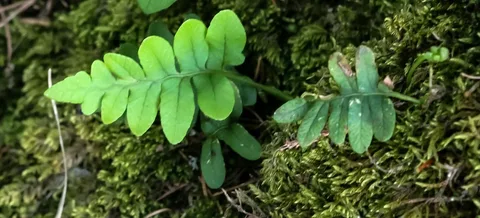
Gewöhnlicher Tüpfelfarn
Polypodium vulgare
Plantae · Tracheophyta · Polypodiaceae · Polypodium · Polypodiales · Polypodiopsida
Auch: Polypodium cambricum, Polypodium interjectum (Hoffm.) Hoffm., Polypodium interjectum var. interjectum
Über die Pflanze
Ausdauernde krautige Pflanze, Farn
Wirkung
- Abführend (leicht)
- Schleimlösend
- Entzündungshemmend
- Harntreibend
- Gallenfluss fördernd
- Schmerzlindernd
Anwendung
- Tee
- Tinktur
- Umschlag
Überlieferte Heilwirkungen
- Husten und Bronchitis
- Verdauungsbeschwerden
- Rheuma und Gicht
- Hauterkrankungen
- Blasen- und Nierenleiden
Erkennungsmerkmale
Kriechendes Rhizom, dunkelbraun mit schuppigen Schuppen; Sori auf der Blattunterseite in Reihen entlang der Blattadern
Wuchs
krautig
Standort
feuchte, schattige oder halbschattige Standorte wie alte Bäume, Mauern oder in Wäldern
Verwendete Pflanzenteile
- Rhizom
- Blätter
Zubereitung
- Tee
- Tinktur
- Salben
- Kosmetikprodukte
Sammeln
- Monate: [5, 6, 7, 8, 9] · Hinweis: Nur gesunde Pflanzen ohne Pilzbefall oder Insektenbefall sammeln. · Bedingungen: Frühmorgens bei trockenem Wetter ernten. Sporen sind nur kurzzeitig keimfähig und sollten sofort getrocknet werden. · Pflanzenteil: Sporen · Reifezustand: reif|überreif
- Monate: [4, 5] · Hinweis: Nur gesunde Pflanzen ohne Pilzbefall oder Insektenbefall sammeln. · Tageszeit: morgens · Bedingungen: Frühmorgens bei trockenem Wetter ernten. Junges Blattmaterial ist am besten geeignet. · Pflanzenteil: Blatt · Reifezustand: jung|zart
- Monate: [3, 4, 5, 9, 10] · Hinweis: Nicht in Naturschutzgebieten oder geschützten Gebieten sammeln. · Tageszeit: morgens · Bedingungen: Nur bei kleinflächiger Nutzung ernten. Vorsichtig mit scharfer Schere abschneiden. · Pflanzenteil: Rhizom
Inhaltsstoffe
- Saccharose, Glucose, Fructose, Tannine, Ätherische Öle, Osladin, Chlorogenic Acid, Astragalin, Hyperoside, Quercetin-Derivate, Polyphenole, Carotenoide, Ecdysteroide, Triterpene, Pterosterone, Rhodoxanthin, Rutinoside
Ätherische Öle
- (3r,3ar,5as,5br,7as,11as,11br)-3-isopropyl-3a,5a,5b,8,8,11a-hexamethyl-1h,2h,3h,4h,5h,6h,7h,7ah,9h,10h,11h,11bh,12h,13h-cyclopenta[a]chrysene
- diploptene
- fernene
- 15-(5,6-dimethylhept-6-en-2-yl)-7,7,12,16-tetramethylpentacyclo[9.7.0.0¹,³.0³,⁸.0¹²,¹⁶]octadecan-6-yl acetate
- 15-(5-ethyl-6-methylhept-6-en-2-yl)-7,7,12,16-tetramethylpentacyclo[9.7.0.0¹,³.0³,⁸.0¹²,¹⁶]octadecan-6-yl acetate
- (5ar,5br,11as,13br)-3-isopropyl-5a,5b,8,8,11a,13b-hexamethyl-1h,2h,4h,5h,6h,7h,7ah,9h,10h,11h,11bh,12h,13h,13ah-cyclopenta[a]chrysene
- 3a,6,6,9a,11a-pentamethyl-1-(6-methylhept-5-en-2-yl)-1h,2h,3h,5h,5ah,7h,8h,9h,9bh,10h,11h-cyclopenta[a]phenanthrene
- (3r,3ar,5as,7as,11as,11br,13as,13br)-3-isopropyl-3a,5a,8,8,11a,13a-hexamethyl-1h,2h,3h,4h,5h,7h,7ah,9h,10h,11h,11bh,12h,13h,13bh-cyclopenta[a]chrysene
- (1s,3r,6s,8s,11r,12s,15r,16r)-15-[(2s,5r)-5,6-dimethylhept-6-en-2-yl]-7,7,12,16-tetramethylpentacyclo[9.7.0.0¹,³.0³,⁸.0¹²,¹⁶]octadecan-6-yl acetate
- 3-isopropyl-5a,5b,8,8,11a,13b-hexamethyl-1h,2h,4h,5h,6h,7h,7ah,9h,10h,11h,11bh,12h,13h,13ah-cyclopenta[a]chrysene
- (3s,3ar,5ar,5br,7as,11as,11br,13as,13bs)-5a,5b,8,8,11a,13b-hexamethyl-3-(prop-1-en-2-yl)-hexadecahydrocyclopenta[a]chrysene
- 2-{5a,5b,8,8,11a,13b-hexamethyl-hexadecahydrocyclopenta[a]chrysen-3-yl}propyl acetate
- (1s,3r,6s,8s,11r,12s,15r,16r)-7,7,12,16-tetramethyl-15-[(2r)-6-methylheptan-2-yl]pentacyclo[9.7.0.0¹,³.0³,⁸.0¹²,¹⁶]octadecan-6-yl acetate
- 7,7,12,16-tetramethyl-15-(6-methylheptan-2-yl)pentacyclo[9.7.0.0¹,³.0³,⁸.0¹²,¹⁶]octadecan-6-yl acetate
- (4as,5s,8as)-1,1,4a-trimethyl-6-methylidene-5-[(3e,7e)-4,8,12-trimethyltrideca-3,7,11-trien-1-yl]-hexahydro-2h-naphthalene
Sicherheit und Wechselwirkungen
Giftigkeit
schwach
Herkunft der Einstufung: Tüpfelfarn: Osladin (Süßstoff) und Saponine; in großen Mengen abführend. ⚠ Farne allgemein enthalten Thiaminase und teils Ptaquilosid — für Polypodium ist beides nicht belegt.
Nebenwirkungen
- Allergische Reaktionen (selten)
- Überdosierung kann abführend wirken
Gegenanzeigen
- Keine ausreichenden Daten für Schwangerschaft
Wechselwirkungen
- Typ: hemmt|traditionelle_kombination · Hinweis: *Polypodium vulgare* könnte durch gerbstoffhaltige Inhaltsstoffe die abführende Wirkung von Senna abschwächen. · Pflanze latein: Senna · Pflanze deutsch: Senna
- Typ: traditionelle_kombination · Hinweis: *Polypodium vulgare* könnte theoretisch mit Schlafmohn in Wechselwirkung treten, da es die Darmbewegung fördert. · Pflanze latein: Papaver somniferum · Pflanze deutsch: Schlafmohn
- Typ: neutral|traditionelle_kombination · Hinweis: *Polypodium vulgare* enthält Polyphenole, die ebenfalls entzündungshemmend wirken können. Kombination möglich, aber keine Studien zu Synergieeffekten. · Pflanze latein: Curcuma longa · Pflanze deutsch: Kurkuma
- Typ: neutral|traditionelle_kombination · Hinweis: *Polypodium vulgare* enthält Polyphenole, die ebenfalls entzündungshemmend wirken können. Kombination möglich, aber keine Studien zu Synergieeffekten. · Pflanze latein: Zingiber officinale · Pflanze deutsch: Ingwer
- Typ: hemmt|traditionelle_kombination · Hinweis: *Polypodium vulgare* könnte durch vasodilatierende Effekte den Blutdruck zusätzlich senken. · Pflanze latein: Ginkgo biloba · Pflanze deutsch: Echte Eiche (Ginkgo)
- Typ: hemmt|traditionelle_kombination · Hinweis: *Polypodium vulgare* könnte durch vasodilatierende Effekte den Blutdruck zusätzlich senken. · Pflanze latein: Allium sativum · Pflanze deutsch: Knoblauch
- Typ: hemmt|traditionelle_kombination · Hinweis: *Polypodium vulgare* könnte durch vasodilatierende Effekte den Blutdruck zusätzlich senken. · Pflanze latein: Hibiscus sabdariffa · Pflanze deutsch: Rote Hibiskusblüte
- Typ: traditionelle_kombination · Hinweis: *Polypodium vulgare* könnte in Kombination mit Weidenrinde zur Behandlung von Gelenkschmerzen sinnvoll sein. · Pflanze latein: Salix alba · Pflanze deutsch: Weidenrinde
- Typ: traditionelle_kombination · Hinweis: *Polypodium vulgare* könnte in Kombination mit Aloë Vera zur Behandlung von Hauterkrankungen sinnvoll sein. · Pflanze latein: Aloe vera · Pflanze deutsch: Aloë-Arten (insbesondere Aloe vera)
- Typ: traditionelle_kombination · Hinweis: *Polypodium vulgare* könnte in Kombination mit Kamille zur Behandlung von Hauterkrankungen sinnvoll sein. · Pflanze latein: Matricaria chamomilla · Pflanze deutsch: Kamille
- Typ: traditionelle_kombination · Hinweis: *Polypodium vulgare* könnte in Kombination mit Devil’s Claw zur Behandlung von Gelenkschmerzen sinnvoll sein. · Pflanze latein: Harpagophytum procumbens · Pflanze deutsch: Devil's Claw (Englisch) oder Harpagophytum (Deutsch)
- Typ: traditionelle_kombination · Hinweis: *Polypodium vulgare* könnte in Kombination mit Pfefferminze zur Behandlung von Verdauungsbeschwerden sinnvoll sein. · Pflanze latein: Mentha piperita · Pflanze deutsch: Pfefferminze
- Typ: traditionelle_kombination · Hinweis: *Polypodium vulgare* könnte in Kombination mit Fenchel zur Behandlung von Verdauungsbeschwerden sinnvoll sein. · Pflanze latein: Foeniculum vulgare · Pflanze deutsch: Fenchel
Quellen
- Typ: wikipedia_de · Url: https://de.wikipedia.org/wiki/Gewöhnlicher_Tüpfelfarn · Titel: Gewöhnlicher Tüpfelfarn
- Typ: wikipedia_en · Url: https://en.wikipedia.org/wiki/Polypodium_vulgare · Titel: Polypodium vulgare
- Typ: wikipedia_en · Url: https://en.wikipedia.org/wiki/Polypodium_vulgare · Titel: Polypodium vulgare
- Typ: pfaf · Url: https://pfaf.org/user/Plant.aspx?LatinName=Polypodium vulgare · Titel: PFAF — Polypodium vulgare
- Typ: lotus · Url: https://lotus.naturalproducts.net/search/simple/Polypodium%20vulgare · Titel: LOTUS — Polypodium vulgare
- Typ: web · Url: https://pmc.ncbi.nlm.nih.gov/articles/PMC8482143/ · Titel: Polypodium vulgare L. (Polypodiaceae) as a Source of Bioactive Compounds: Polyphenolic Profile, Cytotoxicity and Cytoprotective Properties in Different Cell Lines - PMC
- Typ: web · Url: https://www.researchgate.net/publication/328981165_POLYPODIUM_VULGARE_LINN_A_VERSATILE_HERBAL_MEDICINE_A_REVIEW · Titel: (PDF) POLYPODIUM VULGARE LINN. A VERSATILE HERBAL MEDICINE: A REVIEW
- Typ: web · Url: https://link.springer.com/rwe/10.1007/978-3-030-97415-2_22-1 · Titel: Bioactive Compounds in Polypodium vulgare L. (Polypodiaceae) | Springer Nature Link
- Typ: web · Url: https://de.wikipedia.org/wiki/Gewöhnlicher_Tüpfelfarn · Titel: Gewöhnlicher Tüpfelfarn – Wikipedia
- Typ: web · Url: https://www.pflanzenfreunde.com/heilpflanzen/tuepfelfarn.htm · Titel: Gewöhnlicher Tüpfelfarn - Heilpflanze der Volksmedizin
- Typ: web · Url: https://gesundpedia.de/Gewöhnlicher_Tüpfelfarn · Titel: Gewöhnlicher Tüpfelfarn - Verwendung & Nutzen für Gesundheit ...
- Typ: web · Url: https://en.wikipedia.org/wiki/Polypodium_vulgare · Titel: Polypodium vulgare - Wikipedia
- Typ: web · Url: https://plants.ces.ncsu.edu/plants/polypodium-vulgare/ · Titel: Polypodium vulgare (Common Polypody) | North Carolina Extension Gardener Plant Toolbox
- Typ: web · Url: https://pmc.ncbi.nlm.nih.gov/articles/PMC8482143/ · Titel: Polypodium vulgare L. (Polypodiaceae) as a Source of Bioactive Compounds: Polyphenolic Profile, Cytotoxicity and Cytoprotective Properties in Different Cell Lines - PMC
- Typ: web · Url: https://en.wikipedia.org/wiki/Polypodium_vulgare · Titel: Polypodium vulgare - Wikipedia
- Typ: web · Url: https://ijpsr.com/bft-article/polypodium-vulgare-linn-a-versatile-herbal-medicine-a-review/?view=fulltext · Titel: POLYPODIUM VULGARE LINN. A VERSATILE HERBAL MEDICINE: A REVIEW | INTERNATIONAL JOURNAL OF PHARMACEUTICAL SCIENCES AND RESEARCH
- Typ: web · Url: https://pmc.ncbi.nlm.nih.gov/articles/PMC8482143/ · Titel: Polypodium vulgare L. (Polypodiaceae) as a Source of Bioactive Compounds: Polyphenolic Profile, Cytotoxicity and Cytoprotective Properties in Different Cell Lines - PMC